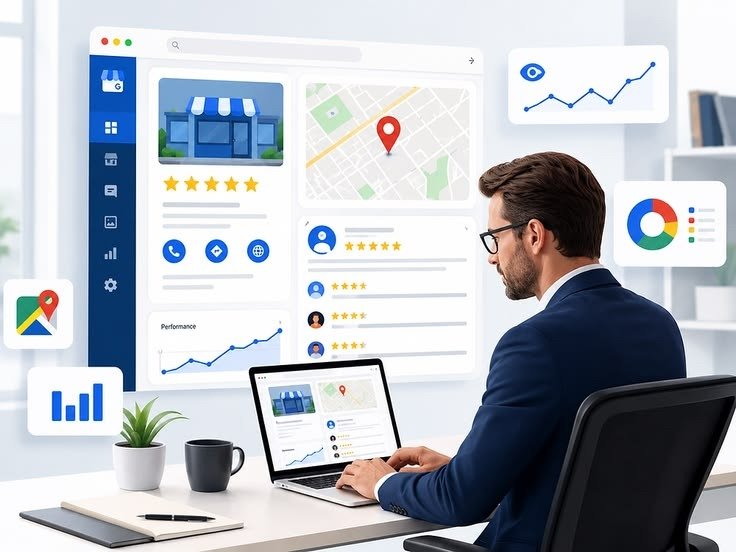


A local SEO audit should show why a business is difficult to find and what to fix first. It should not be a 100-page export of technical warnings with no connection to real local searches or customer actions.
For service businesses, a useful audit connects Google Business Profile, website pages, technical SEO, reviews, local relevance and conversion tracking. The purpose is to create a prioritized improvement plan—not simply collect problems.
Google Business Profile Checks
- Confirm the profile is verified and managed by the business.
- Review the primary and additional categories for accuracy.
- Check business name, phone, website, hours and appointment links.
- Review service areas or address settings based on the real business model.
- Audit services, business description, photos and recent updates.
- Look for unanswered reviews and a realistic review-generation process.
Website and Local Relevance Checks
- Confirm the homepage clearly explains the core service and market.
- Review whether each priority service has a focused page.
- Check whether important cities need genuine local pages or better local context.
- Make sure location claims are accurate and do not imply offices that do not exist.
- Review title tags, headings and content for clear service/location intent.
- Check internal links between services, locations, blogs and case studies.
Technical SEO Checks
- Confirm important pages are indexable.
- Review canonical tags, sitemap coverage and robots directives.
- Check broken internal links and 404 errors.
- Review page speed and mobile usability on priority templates.
- Look for duplicate or near-duplicate service/location pages.
- Confirm structured data is accurate and supported by visible page content.
Authority and Prominence Checks
Local SEO also depends on evidence beyond the website. Review the quality and consistency of important business listings, local mentions and links. Look for genuine opportunities from associations, suppliers, community involvement, partnerships and industry directories.
Avoid judging success by a raw directory count. Consistent, credible references are more valuable than hundreds of low-quality listings.
Review Competitors for Patterns, Not Copying
Compare businesses that appear consistently for your priority searches. Review their page structure, service focus, reviews, categories and local content. The goal is to understand what the market expects, not to reproduce their wording or build fake signals.
If competitors have stronger proof, better service pages or more complete profiles, those gaps become useful priorities.
Check Whether Visibility Becomes Enquiries
An audit should also verify tracking. If calls, forms and bookings are not measured, the business cannot tell whether local visibility is producing useful outcomes.
Use DigiFly’s conversion tracking guide to review the measurement layer and the Google Business Profile checklist for a deeper profile review.
Prioritize the Findings
Not every issue deserves equal urgency. Sort the audit into critical, high-impact and supporting improvements. Fix indexation problems, broken conversion paths and inaccurate business information before spending time on minor wording changes.
A good local SEO plan should make the next 30, 60 and 90 days obvious.
Frequently Asked Questions
Can I do a local SEO audit myself?
Yes. A business owner can review the major items in this checklist. An agency is most useful when the problems span technical SEO, content architecture, GBP and analytics.
How often should local SEO be audited?
A full audit is useful when starting a campaign, after major website changes or when performance shifts unexpectedly. Smaller profile and tracking checks can happen monthly.
Does an audit guarantee better rankings?
No. An audit identifies opportunities and risks. Results depend on the quality of implementation, competition, location and the strength of the business’s overall local presence.
Turn the Audit Into an Action Plan
Local SEO improves when the business fixes the highest-impact gaps in a sensible order. If you want help reviewing the full local search system, DigiFly provides local SEO and Google Business Profile services for service businesses across Canada.